Publications
Selected work from Dr. Friedman and collaborators in neural interfaces, motor restoration, and cognitive neuroscience.
Selected research

Restoring natural walking after amputation
In seven people with below-knee amputations, a surgically reconstructed muscle interface supported continuous neural control of a powered ankle. Compared with seven matched controls, participants walked faster and adapted more naturally to changing terrain.
Song H, Hsieh TH, Yeon SH, et al., including Friedman GN. Continuous neural control of a bionic limb restores biomimetic gait after amputation. Nature Medicine. 2024;30:2010–2019.
Engineering living neural interfaces
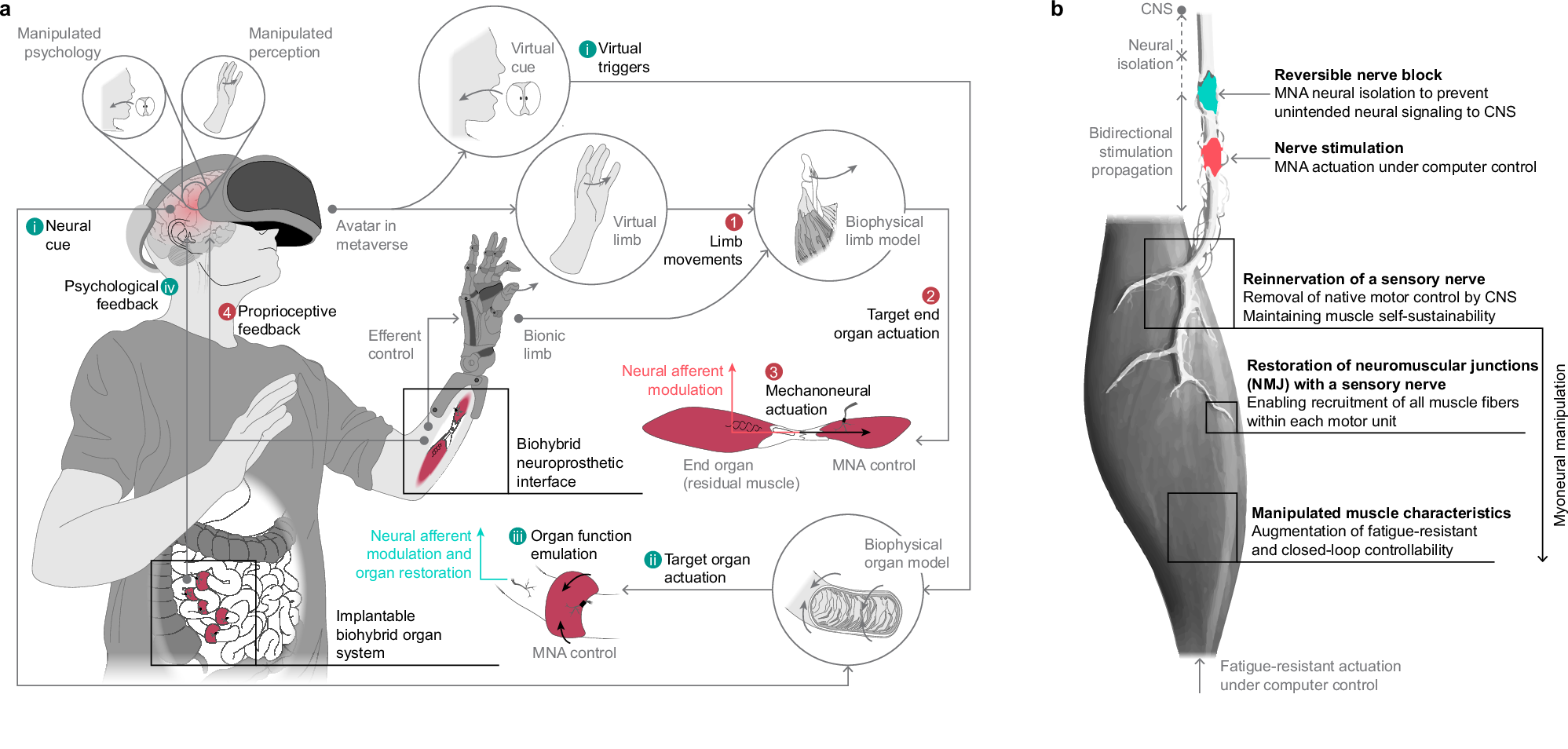
In a rodent model, sensory reinnervation transformed muscle into a fatigue-resistant, computer-controlled actuator. Closed-loop stimulation enabled sustained force control and proof-of-concept interfaces for sensory feedback and organ actuation.
Song H, Herrera-Arcos G, Friedman GN, et al. A myoneural actuator with engineered biophysics for implantable biohybrid systems. Nature Communications. 2026;17:2584.

Decoding natural arm movements
Wireless high-density recordings from premotor cortex revealed complementary frequency-band signals that predicted the onset and direction of natural reaching in a macaque. This was an offline decoding proof of concept.
Hu K, Jamali M, Moses ZB, Ortega CA, Friedman GN, Xu W, Williams ZM. Decoding unconstrained arm movements in primates using high-density electrocorticography signals for brain-machine interface use. Scientific Reports. 2018;8:10583.
More research highlights
Recovering neural representations of self and other
In a mouse model, restoring Shank3 expression rebalanced prefrontal neurons’ representation of self and other and improved social behavior over several weeks.
Lee DK, Li SW, Bounni F, Friedman G, et al. Reduced sociability and social agency encoding in adult Shank3-mutant mice are restored through gene re-expression in real time. Nature Neuroscience. 2021;24:1243–1255.
Read the paper →Integrating a bionic knee with the body
Combining reconstructed muscle pairs, implanted electrodes, and a bone-anchored prosthesis enabled more versatile voluntary knee control in a small clinical study. Two participants received the complete integrated system.
Shu T, Levine D, Yeon SH, … Friedman G, Herr H. Tissue-integrated bionic knee restores versatile legged movement after amputation. Science. 2025;389:eadv3223.
Read the paper →How prior learning shapes new learning
Human visual-search experiments showed that learning can persist across days while limiting subsequent learning of similar features. An intervening task reduced this suppression, revealing how prior experience can influence new learning.
Friedman GN, Johnson L, Williams ZM. Long-Term Visual Memory and Its Role in Learning Suppression. Frontiers in Psychology. 2018;9:1896.
Read the paper →